



Open IFS therapy
You don't have to 'fit into' IFS therapy...
As IFS therapy grows in popularity, we hear a lot about IFS success stories. But what if you're an IFS misfit who struggles with IFS therapy? Holding the principles of IFS is possible even when some of the IFS 'protocols' or IFS language don't feel quite right for your system. If traditional IFS is not a good fit, maybe we need to be more OPEN...

IFS therapy has changed the way I understand myself and my clients ... AND
to my European ears, IFS can sound quite 'American.' The way it's marketed and taught can feel dogmatic and over the top, which makes some of my parts suspicious.
Has IFS become a trendy brand in a crowded therapy market where competition replaces dialogue between modalities? Am I alone in believing that:
No therapy 'model' works for everyone (not even IFS).
For me, IFS therapy is NOT the magic bullet (although I do have parts that wish it was!). The human psyche is as deep, complex and mysterious as the larger systems where it is embedded, yet IFS can be a helpful lens, or better, a way of cleaning the lens through which we view ourselves and others.
Protocols can feel like something is being done to us.
If you've heard
Schwartz speak, you'll know IFS is appealingly simple. It's easy to 'talk the IFS talk' but when our human messiness spills out of standard IFS protocols and acronyms, we may need to go off the 'IFS script' and be open. IFS offers a map but it is not the territory and each territory is unique.
'Unburdening' can become a burden in IFS therapy
'Unburdening' may not be the holy grail of IFS treatment: when therapists' and/or clients' parts are on a mission to 'get to the exiles', protectors often get more polarised and block the process. By relating to all parts with curiosity and compassion, healing can unfold organically within each system.
'Therapy models' are not something to get right, not an end but a means, not something to fit into but rather something to grow out of...

IFS therapy & me...
My name is Valerie, I've been a 'constructively critical' student of IFS since 2017. I've completed levels 1 & 2 training plus an additional IFIO training with the IFS Institute. I've also attended many advanced workshops with senior lead IFS trainers like Paul Ginter, Frank Anderson, Cece Sykes, Tony Herbine-Blank and more.
The core principles of IFS immediately resonated with me. I've always understood and experienced the human psyche as beautifully varied and naturally multiple. We all have 'subpersonalities' or 'parts' and we need this multiplicity to be in the world, We also can experience a deeper source of inner cohesion which
connects us to broader dimensions of meaning and purpose (SELF).
IFS therapy complements my previous training in Psychosynthesis (PS), expanding on how our subpersonalities interact inside us as systems, Schwartz has a PhD. in systemic family therapy. Unlike PS, IFS is taught as a 'manualised' approach with 'protocols', techniques and mnemonics that are very accessible and often impactful, but may not suit every system.
While I draw on IFS every day in my work, you may say I am in an open relationship with IFS. I have parts who've never quite fitted into the 'pure' IFS mould and respond best to less structured, more intuitively relational approaches. In therapy, I value flexibility, spontaneity and a questioning spirit, especially when applying therapeutic theories to the messy mystery of real life.
I hold IFS in the context of what came before it—psychodynamic, humanistic, and transpersonal psychotherapies—and integrate it with other contemporary modalities I've trained in.
These include Janina Fisher's
trauma-informed parts model, Diana Fosha's attachment-based experiential work (which focuses on moment-to-moment attunement in the therapeutic relationship), and Sensorimotor Psychotherapy, among others."
My IFS training/ CPD
Learning to trust the self-righting impulse within my clients' (and my own) system is more important to me than fidelity to any 'therapy model'.
Why protector parts may not buy into IFS 'hope merchanting'
IFS therapy offers a hopeful and non-pathologising framework for nurturing self-understanding and self-compassion. Schwartz often talks about being a 'hope merchant', and even used to encourage students to borrow his confidence in the model when negotiating with protectors. While this is an invitation to trust the innate qualities of Self we all share, this 'hope agenda' can sometimes backfire...
In my experience, it is hard-working manager parts in both therapists and clients, who are keen to take Schwartz up on his offer. Like good scouts, they want to get IFS right and march through the IFS steps, to avoid the very feelings of inadequacy and shame that most need healing.
Offering hope when asking protectors to 'step back' is a delicate dance which takes a lot of integrity, honesty and respect. Therapists with little training and experience in connecting with their own parts may not be convincing guides in the IFS process. Conversely, seasoned IFSers risk blending with dogmatic parts who will sooner point to the client's lack of access to Self, than question how helpful the prescribed protocol is to the person's needs.
Hope, sometimes against all odds, is key in therapy. However pinning such hope onto any one technique or approach can create false expectations and intensify an inner polarity between eager parts desperately wanting us to be 'healed' once and for all, and more cautious ones who have learnt to survive through numbing, avoidance, distraction or constant battle. Change may feel like too big a risk and 'healing', a luxury we can't afford!
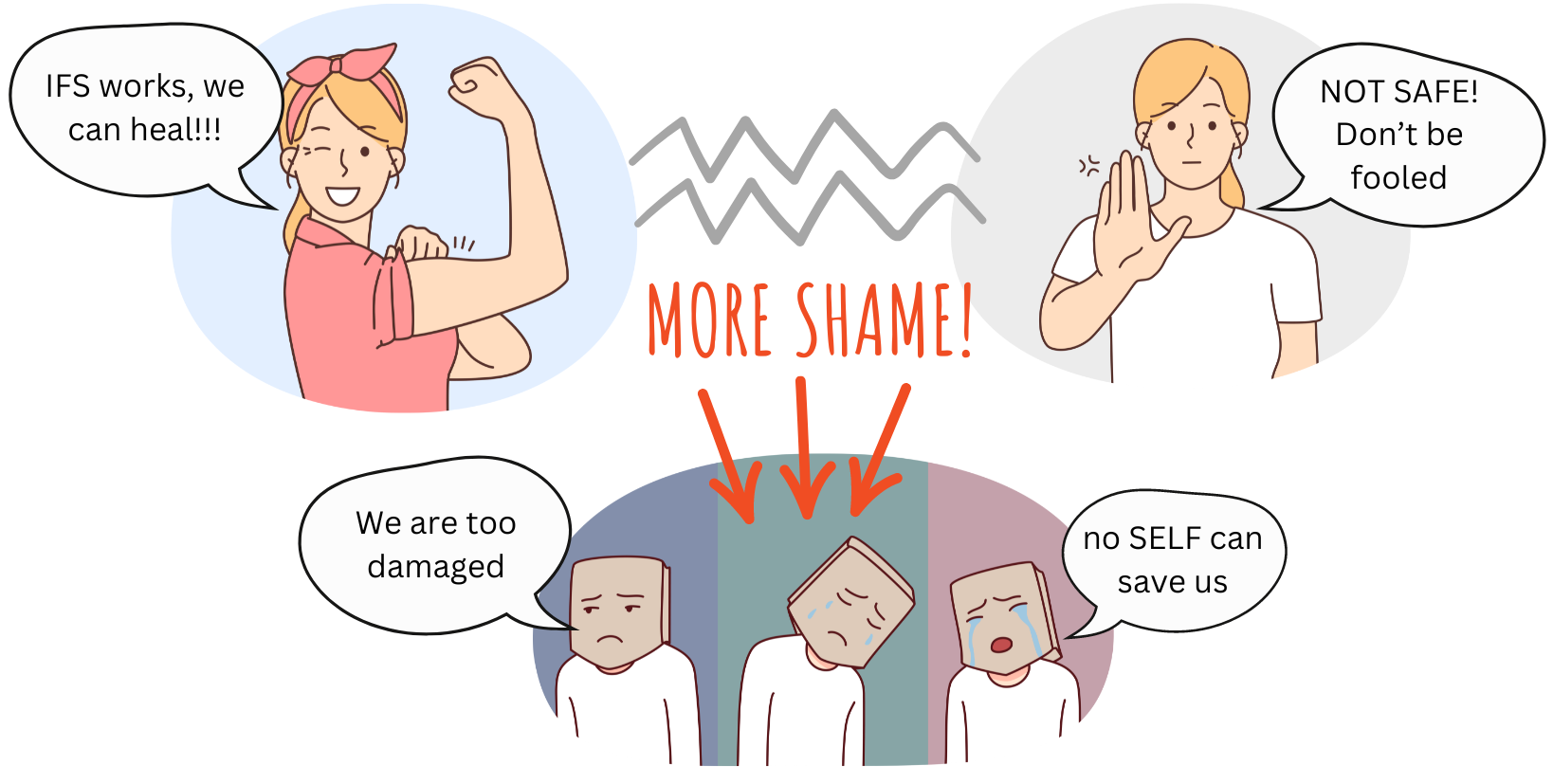
When we get stuck in this inner conflict, our most sensitive, wounded parts can end up feeling even more broken, deficient and ashamed: 'If IFS therapy is so great and everybody else gets better fast, there must be something so very wrong with me if I don't!'
Especially when it comes to complex, relational injury and attachment wounds, slower is often faster.
It can be counterproductive and potentially re-traumatising when IFS therapists' parts seek to fast-track the sort or 'life-changing' unburdening' (another IFS term I am not particularly fond of) Dick Schwartz is famous for. What shall we do then? Our manager parts might want to know...
IFS invites us to think systemically
IFS clusters parts according to 3 main roles: managers focused on control, fire-fighters focused on relief and exiles, the parts who feel and get wounded most deeply. IFS lead trainer Cece Sykes calls this the 'three legged stool'. Each part/cluster of parts is a necessary 'leg of the stool' and is fully deserving of attention and appreciation. Tracking how various parts trigger each other or polarise to protect what is most tender within us is a great first step towards unblending (differentiating).
When the members of our inner family fight or avoid each other, we experience psychological distress.
In IFS therapy, we often hear Self has no agenda; this also applies to following the 'IFS steps to healing'
Healing can take many forms
I find it helpful in my own system to normalise that healing does not always follow 'IFS protocols' nor does it need to be a BIG event. For some of us, healing may be a subtle and gradual release; it may occur spontaneously, within and beyond therapy, through the body or through insight.
Also,
in this troubled world, HEALING can only be an ongoing, often challenging, process: We are never fully healed AND we always need each other in healing!
'Unblending' IS healing
Unblending means separating/differentiating from a part in service of a 'Self-to-Part' relationship. Unblending can be tricky: manager parts may be reluctant to unblend out of a sense of duty and responsibility, while exiles often fear that if they separate, they'll be abandoned again.
Yet, paradoxically, the more parts unblend, the more they may experience an inner source of compassion, courage and creativity (i.e., Self). Possibly, the biggest burden a system can carry is the experience of having 'NO Self' to turn to (often felt as a void, unbearable aloneness, shame, hopelessness and rage).
Adapting Rogers' famous quote, we may say:
'the curious paradox is that when Self accepts parts just as they are, then they can change'.
Unblending is not only a precondition to healing - it is healing in and of itself, a process of emergent hope.
Each time a part carrying extreme feelings or beliefs (what IFS calls burdens) can unblend, even briefly, we're infused with a sense of possibility. Like sunlight breaking through thick cloud, unblending reveals a broader, more creative perspective: what IFS calls Self.
Each part of us is, at its core, connected to this Self energy. The more our parts feel this connection, the more our whole inner family can contribute to us living meaningfully and generously.
If Protectors are not welcome in therapy, they will hold tight: therapists' own protectors parts call that resistance...
While the focus in IFS therapy is on the internal, if parts don't feel welcome by the therapist in the here and now of the therapy hour, protectors will take over to maintain safety. For people who have been hurt in early relationships, feeling
safe enough in the therapeutic relationship may be a precondition for the inner work of IFS. Therapy can be triggering
and
for most of us healing is an ongoing, non-linear process which requires patience, and perseverance (and yes. IFS has a list if P qualities too,,,). Enough
trust may need to be earned over time: inside ourselves as well as within the therapeutic relationship.